Do you know what could disrupt your business?
We make cybersecurity work for your business. And we prove it with CRI by Widefense.
Understand what could threaten your business continuity, how prepared your organization is, and whether it can respond and keep operating when it matters most.
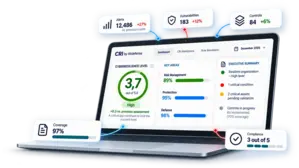
The problem isn't a lack of technology. It's a lack of clarity to make decisions.
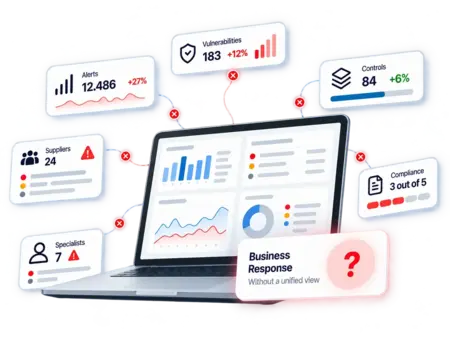
Can your business keep operating?
You may have tools, controls, vendors, specialists, and reports. Each provides a different piece of the picture.
The challenge arises when those signals remain disconnected, making it difficult to understand what could disrupt business continuity, where protection falls short, and what needs to be addressed first.
More data doesn't necessarily lead to better decisions.
Measuring activity is not the same as measuring capability.
Alerts handled. Endpoints protected. Vulnerabilities detected. Controls audited.
All of this information matters. But on its own, it doesn't answer the question that matters most to the business:
If something happens today, can we respond, recover, and keep operating?
Cybersecurity isn't the goal. It's the means. The goal is to enable the business to keep operating, make informed decisions, and compete with confidence.
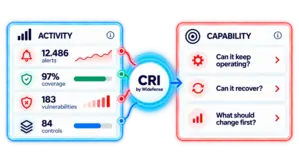
Measuring activity is not the same as measuring capacity.
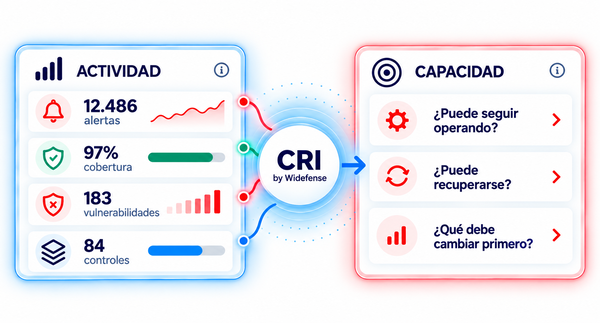
Alerts addressed. Endpoints protected. Vulnerabilities detected. Controls audited.
All of that information is still necessary. But on its own, it doesn’t answer the question that matters to the business:
If something happens today, can we respond, recover, and continue operating?
Cybersecurity isn’t the goal. It’s the means. The goal is for the business to be able to continue operating, making decisions, and competing with confidence.
Three questions every organization should be able to answer.
Determine whether your protection is as effective as your business needs it to be.
Assess your organization's ability to detect, contain, recover, and maintain operations when preventive controls are not enough.
One answer. One level. Evidence behind every point.
CRI by Widefense translates these questions into a CyberResilience Level on a scale of 1 to 5, supported by evidence that explains what limits your organization's resilience and which decisions could improve it.
One answer. One level. And the evidence to understand why.
CYBERRESILIENCE LEVEL
+0.3 vs. previous assessment
A critical gap continues to limit the current level.
WHAT LIMITS IT TODAY
Risk Understanding
Critical dependency without validated recovery
Explore the three questions to see the supporting evidence and the next priority action.
LIMITING FACTOR
Critical dependency without validated recovery
EVIDENCE
Critical Asset Recovery
2 critical assets awaiting validation.
Verified evidence · September 29, 2026
PRIORITY ACTION
Validate the recovery of critical assets and address the critical dependency before extending controls to lower-impact areas.
LIMITING FACTOR
Incomplete coverage of critical assets
EVIDENCE
Protection Coverage
95% of critical assets have verified coverage.
Verified evidence · September 29, 2026
PRIORITY ACTION
Complete the protection coverage of critical assets before extending controls to lower-impact assets.
LIMITING FACTOR
One critical scenario still requires a faster response
EVIDENCE
Response Capability
5 of 6 scenarios meet the defined target.
Verified evidence · September 29, 2026
PRIORITY ACTION
Improve the response procedure for the remaining scenario and reassess it after the next validation.
Your first Cyber Resilience Level in seven business days.
We start by understanding what can't be stopped. Then we connect controls, capabilities, and evidence. In seven days, you'll get an initial assessment, identify the factor that's currently holding you back, and determine the priorities for improvement.
Understanding the Business
We identify which processes cannot be halted, the assets that support them, and the scenarios that could affect business continuity.
Verify Protection and Capabilities
We correlate controls, tools, defensive capabilities, and available evidence to determine what is working and what remains vulnerable.
Find Out Your Level
You’ll receive your Cyber Resilience Level, find out what’s holding you back today, and learn the top priorities for improving it.
Demonstrating Progress
The evidence is updated and makes it possible to verify whether decisions are actually changing the state of the business
Understand how CRI builds an evidence-based view of your CyberResilience Level.
We begin by understanding what your business needs to keep operating. Then we connect risks, controls, capabilities, and evidence to establish a CyberResilience Level, identify what limits it, and prioritize the decisions that can improve it.
We identify the processes that must keep operating, the assets they depend on, and the scenarios that could disrupt business continuity.
We bring together existing controls, technologies, defensive capabilities, and supporting evidence to understand what's working and where critical gaps remain.
We evaluate the organization's ability to detect, contain, respond, recover, and maintain operations under relevant scenarios.
CRI brings the findings together into an evidence-based CyberResilience Level, identifies the main limiting factors, and prioritizes improvement actions. Subsequent assessments help determine whether the decisions taken have improved the organization's resilience.
One evidence-based view. The right perspective for every role.
CRI brings executive leadership, security, and operations together around the same evidence. What changes is not the underlying reality, but the level of detail each role needs to make decisions, set priorities, and take action.
SHARED EVIDENCE
3.7
HIGH
What limits the current Level
Incomplete coverage of critical assets
Evidence
95% verified coverage
September 29, 2026
EXECUTIVE LEADERSHIP
What decision does the business need to make?
A protection gap affecting critical assets continues to limit the organization's current CyberResilience Level.
What matters:
Business continuity depends on closing this critical gap before the current level of protection can be considered sufficient.
Decision:
Prioritize closing the critical gap before expanding investment in lower-impact areas.
SHARED EVIDENCE
3.7
HIGH
What limits the current Level
Incomplete coverage of critical assets
Evidence
95% verified coverage
September 29, 2026
SECURITY
What needs to be improved first?
Verified protection coverage for critical assets stands at 95%, but the remaining gap continues to limit the organization's CyberResilience Level.
What matters:
The evidence identifies the remaining protection gap and helps determine where improvement efforts should be focused.
Priority:
Close the remaining coverage gap and reassess the evidence to verify whether protection has improved.
SHARED EVIDENCE
3.7
HIGH
What limits the current Level
Incomplete coverage of critical assets
Evidence
95% verified coverage
September 29, 2026
OPERATIONS
What needs to be implemented and demonstrated?
A protection gap has been identified in critical assets, with a defined action to address it.
Action:
Complete the outstanding protection coverage for critical assets.
Expected outcome:
Verified coverage of all assets identified as critical.
Evidence-based verification:
Feed the new evidence back into CRI to determine whether the limiting condition has improved.
Knowing what needs to change doesn't change anything. Taking action on it does.
CRI identifies what limits your CyberResilience Level and provides evidence to assess whether it improves. When action requires specialized cybersecurity execution, CyberDefense provides the services to make it happen.
CRI BY WIDEFENSE
Identify. Prioritize. Demonstrate.
- What is limiting your CyberResilience Level today?
- What should be addressed first?
- What evidence demonstrates improvement?
Intelligence that informs decisions.
CYBERDEFENSE
Turn priorities into action.
Detection and Response
Detect, investigate, contain, and respond to cybersecurity threats and incidents.
Platform Operations
Operate, optimize, and maintain cybersecurity platforms.
Dedicated Specialists
Provide dedicated cybersecurity expertise integrated into the client's operations.
Technology Integration
Design, implement, and integrate technologies that enable the required cybersecurity capabilities.
CRI → Priorities → CyberDefense → Execution → Evidence → Updated CyberResilience Level
CRI provides intelligence and evidence. CyberDefense delivers execution.
Four decades of learning what businesses need to protect and keep operating.
Widefense's approach to CyberResilience is grounded in decades of experience protecting organizations, operating cybersecurity capabilities, responding to incidents, and working alongside teams that needed more than technology. They needed to understand whether they were prepared to respond and keep operating.
40
YEARS
protecting, operating, and learning alongside our clients.
From protecting technology to demonstrating CyberResilience.
A STORY FROM THE FIELD
They came looking for antivirus software after a ransomware attack. The conversation became about business resilience.
An industrial organization approached Widefense after experiencing a ransomware attack. Their initial question was technical: what antivirus solution should they use to reduce the risk of another incident?
The conversation changed when we moved beyond the technology itself and began exploring how the organization managed cybersecurity, which business operations it needed to protect, and how it could demonstrate meaningful improvement.
Over time, technology became a means to an end rather than the strategy itself: addressing specific needs, supporting informed decisions, and providing evidence of progress to executive leadership.
That experience continues to inform the thinking behind CRI by Widefense today.
You don't need another opinion on cybersecurity. You need to know where your organization stands.
Take the first step toward understanding your organization's CyberResilience Level and the factors that may limit its ability to keep operating.
CyberResilience Level · Limiting Factors · Improvement Priorities