
Measure, Manage, and Demonstrate Your Business's Cyber Resilience
CRI is an intelligence system designed to help your business keep operating in the face of cybersecurity incidents—and demonstrate its readiness with evidence.
It brings together risk, protection, response capabilities, and evidence into a single CyberResilience Level, showing what is limiting it today and which actions to prioritize for improvement.
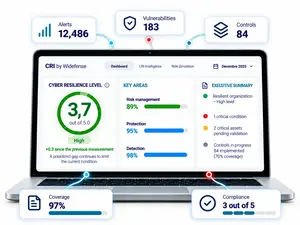
Cybersecurity generates data. CRI turns it into intelligence for better decisions.
What could affect or disrupt our business?
Identify critical processes, assets, and scenarios to understand where a cybersecurity issue could have a material impact on the business.
Is our cybersecurity as effective as the business needs it to be?
Connect controls, tools, and evidence to verify how effectively protection is working and identify the gaps that remain.
Can we respond, recover, and continue operating?
Assess whether the organization can detect, contain, recover, and keep operating when protective measures fall short.
Three questions. One CyberResilience Level. Evidence behind every point.
One level isn't enough. You need to understand what's holding you back.
CRI brings scattered evidence together to show where your organization stands today, what is limiting its CyberResilience Level, and which action should be prioritized to improve it.
CYBERRESILIENCE LEVEL
+0.3 since the previous measurement
A key gap continues to limit the current situation.
WHAT LIMITS IT TODAY
Understanding Risks
Critical dependency without validated recovery
Explore the three questions to see the supporting evidence and the next priority action.
LIMITING FACTOR
Critical dependency without validated recovery
EVIDENCE
Recovery of Critical Assets
2 critical assets pending validation
Verified evidence · Sept. 29, 2026
PRIORITY ACTION
Verify the recovery of critical assets and resolve the dependency before extending controls to lower-impact assets.
LIMITING FACTOR
Incomplete coverage of critical assets
EVIDENCE
Protection Coverage
95% of critical assets with verified coverage
Verified evidence · Sept. 29, 2026
PRIORITY ACTION
Complete coverage of critical assets before extending controls to assets with a lower impact.
LIMITING FACTOR
Response time remains insufficient in one critical scenario.
EVIDENCE
Response capability
5 of 6 scenarios within the defined target
Verified evidence · Sept. 29, 2026
PRIORITY ACTION
Adjust the procedure for the pending scenario and measure again after the next validation.
Measuring is useful when the next decision becomes clear.
First, we establish where you stand. Then CRI tracks how that changes.
The initial assessment establishes your starting point. From there, CRI incorporates available evidence and integrations to track changes, update your CyberResilience Level, and identify what should be prioritized.
We identify critical processes, assets, obligations, and scenarios that may materially affect business continuity.
The initial assessment brings together relevant evaluations and available evidence, connecting the applicable sources to establish your organization's starting point.
CRI presents your CyberResilience Level, the factor limiting it, and the actions that should be prioritized for improvement.
As new evidence becomes available, CRI updates the reading according to your plan's measurement cadence, helping you verify whether the situation has improved.
CRI isn't a one-time assessment. It turns updated evidence into a clearer understanding of how your CyberResilience is changing.
The same condition. The information each role needs to make a decision.
CRI maintains a single view of cyber resilience. What varies is the level of detail each decision-maker needs to see in order to make decisions, validate information, or take action.
What could affect business continuity, and what needs to be decided?
The board needs to understand the state of the business, not review individual tools. CRI shows the CyberResilience Level, how it has changed, what is limiting it, and where critical conditions may affect business continuity and investment priorities.
LEVEL
3.7 · High
TREND
+0.3 since the previous measurement
TODAY'S LIMIT
Recovery of critical asset not yet validated
PRIORITY
Validate recovery of critical assets
What is limiting our CyberResilience Level, and what evidence supports it?
Security teams can examine the CyberResilience Level in greater detail, reviewing controls, exposure, evidence, incidents, and actions to identify what to address first and verify whether conditions improve.
PROTECTION
95% coverage
PRIORITY GAP
Critical asset recovery not validated
EVIDENCE
2 critical assets pending validation
ACTION
Validate recovery before extending lower-priority controls
What must keep operating, and what needs attention?
Operations teams connect the evidence to critical assets, tools, integrations, and response capabilities to determine what needs to be done and how to verify the outcome.
AFFECTED ASSETS
2 pending recovery
STATUS
Recovery of critical assets pending validation
REQUIRED EVIDENCE
Documented results of recovery validation test
ACTION
Validate recovery and document the result
One reality. Different decisions. Shared evidence.
Depth changes. What CRI measures does not.
All plans measure the same level of cyber resilience. What varies is the frequency with which the metric is updated, the rigor of the evidence, and the depth of management and governance required.
To measure CyberResilience reliably and maintain priorities month after month.
RECALCULATION
Monthly
EVIDENCE
Declared evidence, with a confidence indicator and expiration alerts
SUPPORT
Integration health monitoring and support during business hours
CASE MANAGEMENT
Prioritized gaps with status tracking
REPORTING AND BUSINESS REVIEWS
Automated monthly executive report · No business review included
AI EXECUTIVE ASSISTANT
Questions about your executive report
BUSINESS ANALYSIS
CyberResilience Level · Limiting factor · Trend
Understand where you stand and what to prioritize.
To manage cybersecurity gaps and exposure on an ongoing basis, connecting evidence with operational decisions.
RECALCULATION
Weekly
EVIDENCE
Declared and integration-verified evidence · Evidence required for critical controls
SUPPORT
CRI product support and monitoring of the CRI panel and integrations
CASE MANAGEMENT
Cases with assigned owners, deadlines, and evidence of closure
REPORTING AND BUSINESS REVIEWS
Monthly executive report with analyst review · Semiannual business review
AI EXECUTIVE ASSISTANT
Questions about data from the reporting period
BUSINESS ANALYSIS
CyberResilience Level · Limiting factor · Trend · Impact and exposure by critical business process
Turn gaps into verifiable actions.
For organizations that need to govern and demonstrate CyberResilience with evidence for the board, risk management, compliance, and regulators.
RECALCULATION
Continuous, with event-driven updates
EVIDENCE
Verified and audited evidence, with validity and expiration tracking
SUPPORT
CRI product support and monitoring of the CRI panel and integrations · No dedicated account manager included
CASE MANAGEMENT AND GOVERNANCE
Cases, exceptions, risk decisions, and traceability of governance decisions
REPORTING AND BUSINESS REVIEWS
Monthly executive report with analyst review · Quarterly business review
AI EXECUTIVE ASSISTANT
Advanced queries and event-based narratives
THIRD-PARTY RISK
Critical suppliers linked to business processes
BUSINESS ANALYSIS
CyberResilience Level · Limiting factor · Trend · Impact and exposure by critical business process
COMING SOON
Probability of loss and investment análisis
Govern and demonstrate CyberResilience with greater depth.
INCLUDED IN ALL PLANS
One-time activation: initial assessment and connection to your existing tools · Up to five integrations from the catalog included · Critical processes, critical assets, and regulatory obligations according to the applicable scope · CyberResilience Level, limiting factor, and trend · Traceability to the underlying data · Prioritized 30-, 60-, and 90-day action plans.
CRI connects the technologies you already use. CyberDefense provides separate services to implement and operate the capabilities you need.
Knowing what needs to change doesn't change anything. Taking action on it does.
CRI identifies what is limiting your cyber resilience, prioritizes what needs to change, and shows whether the situation is improving. When specialized execution is needed, CyberDefense can help implement those changes.
Identify what limits your CyberResilience Level
Decide what needs to change first
Implement prioritized changes with specialized services when needed.
Verify the outcome with new evidence.
CRI updates the Level and shows whether the condition has improved.
Identify What Limits Your Cyber Resilience
Decide what needs to change first
Make the change when you need to
Check the result
CRI indicates whether the condition has improved
CRI isn't just another layer of complexity. It's the way to turn evidence into decisions.
- A system that works with evidence from the organization's real operations.
- Intelligence that interprets, prioritizes, and identifies what to address first.
- A system that translates the ability to keep operating into a business-level measure.
- Evidence traceable from the CyberResilience Level to the underlying data.
- A product developed by Widefense.
-
An annual consulting assessment that ends with a report.
- A dashboard filled with metrics but no clear decisions.
- An audit or certification that approves or rejects controls.
- A promise that everything is under control.
- A collection of components customers need to understand or manage.
The value of CRI isn't in showing more data. It's in revealing your CyberResilience Level, understanding what limits it, and identifying the decisions that can improve it.
You don't need another opinion on your cybersecurity. You need to know where you stand.
CyberResilience Level · Limiting Factor · Priority Action